
DreamHost vs Hostinger: Which Host Is Better in 2026?
A 1996-born, employee-owned American veteran against a 2004 Lithuanian growth rocket: DreamHost and Hostinger come from different worlds, yet they land on the same shopping lists for affordable web hosting. DreamHost runs its own data centers in Oregon and Virginia, throws in unmetered bandwidth on nearly every product, backs hosting with a 100% uptime guarantee and a 30-day money-back policy, and doubles as an ICANN-accredited registrar with 400+ TLDs and free lifetime WHOIS privacy. Hostinger counters with hard numbers from the DohoHub monitor — 9.5/10 performance, 9.0/10 uptime and a perfect 10.0 value score — plus a modern LiteSpeed + NVMe stack, ten data centers on four continents and an entry plan that bundles a free domain, SSL, email and CDN for $2.99/mo. Below we break down pricing (including the renewal jumps both hosts hide behind promo rates), performance, features, support and data-center reach, then tell you exactly which one to buy in 2026.
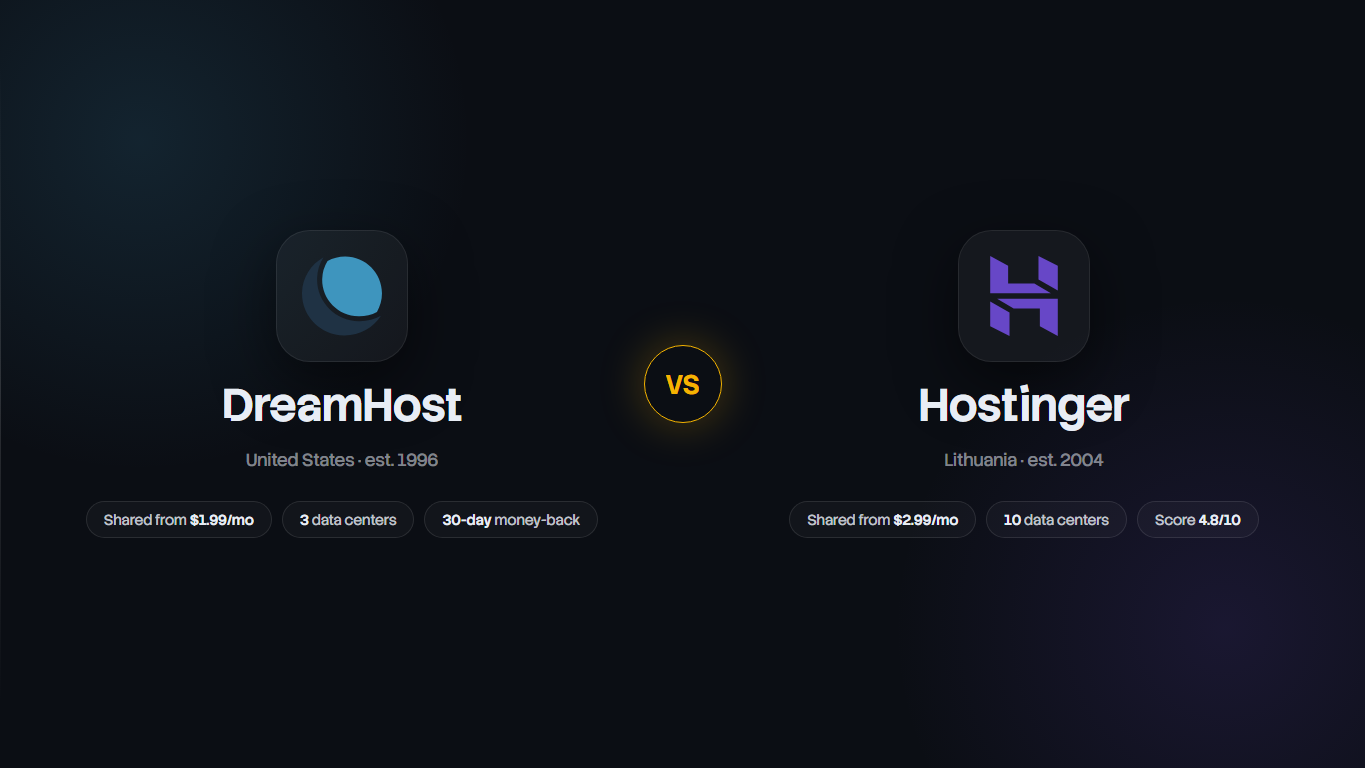
At a glance
| DreamHost | Hostinger | |
|---|---|---|
| Founded | 1996 — employee-owned | 2004 |
| Headquarters | Brea, California, USA | Kaunas, Lithuania |
| Data centers | 3 — Hillsboro (OR), Ashburn (VA), Amsterdam | 10 — USA, UK, Netherlands, Lithuania, Brazil, India, Singapore, Australia |
| Shared hosting from | $1.99/mo (renews at $11.99) | $2.99/mo (renews at $10.99) |
| VPS from | $5.99/mo (renews at $15.99) | $6.49/mo (renews at $11.99) |
| DohoHub monitor | Not yet scored | 4.8/10 overall · 9.5/10 performance · 9.0/10 uptime · 10.0 value |
| Money-back guarantee | 30 days (hosting plans) | 30 days |
| Support | 24/7 live chat & tickets | 24/7 live chat & tickets, ~2-minute replies in 20+ languages |
| Payments | Credit/debit cards, PayPal | Cards, PayPal, Google Pay, crypto |
Pricing: the lowest entry vs the gentlest renewal
On the sticker, DreamHost wins. Its shared plans start at $1.99/mo on the Launch tier — the cheapest shared hosting of the pair — with Growth at $3.49/mo and Scale at $7.99/mo. Hostinger's entry Premium plan costs $2.99/mo with 20 GB of NVMe storage, and its Unlimited tier adds more room at $3.99/mo. All six shared plans include a free domain and free SSL.
| Shared plan | Intro price | Renewal price | What you get |
|---|---|---|---|
| DreamHost Launch | $1.99/mo | $11.99/mo | Free domain, free SSL, unmetered bandwidth |
| DreamHost Growth | $3.49/mo | $13.99/mo | Everything in Launch, more sites |
| DreamHost Scale | $7.99/mo | $27.99/mo | Top shared tier, more resources |
| Hostinger Premium | $2.99/mo | $10.99/mo | 20 GB NVMe, free domain, SSL & email |
| Hostinger Unlimited | $3.99/mo | $16.99/mo | 50 GB NVMe, more sites, free CDN |
The renewal math flips the story. DreamHost's Launch jumps roughly 6x from $1.99 to $11.99/mo when the promo term ends, while Hostinger's Premium rises 3.7x to $10.99/mo — actually cheaper than DreamHost at renewal. The same pattern repeats on VPS: DreamHost's Stack 4 undercuts Hostinger's KVM 1 at signup ($5.99 vs $6.49 for 4 GB RAM), but at renewal KVM 1 costs $11.99/mo against Stack 4's $15.99/mo. If you will keep the plan for years, Hostinger is the cheaper long-term bet; if you want the lowest possible first invoice, DreamHost takes it.
Performance and uptime
On the evidence we track, Hostinger has the measurable edge. The DohoHub monitor currently scores Hostinger 9.5/10 for performance and 9.0/10 for uptime, backed by a LiteSpeed web server, NVMe storage, a built-in CDN and a Cloudflare-protected 1 Gbps network — one of the fastest budget stacks we follow. DreamHost is not yet scored on our monitor. What it offers instead is a promise with teeth: a written 100% uptime guarantee, its own purpose-built US data centers and unmetered bandwidth on nearly every product, so a traffic spike never becomes an overage bill. Note that DreamHost's shared plans run on SSD without LiteSpeed, which typically trails a tuned LiteSpeed + NVMe setup on dynamic WordPress workloads.
Features and platform breadth
Hostinger's catalog is wider: shared hosting, KVM VPS, cloud hosting, reseller plans, WordPress tooling, email marketing, a website builder, SSL, premium DNS, a CDN, a VPN, domain registration and AI products such as Managed OpenClaw from $5.99/mo. DreamHost's strength is depth rather than breadth: everything a US-focused site needs in one account — shared, VPS, dedicated, DreamPress managed WordPress, business email from $1.67/mo, the Remixer AI website builder and 400+ domain TLDs as an ICANN-accredited registrar with free lifetime WHOIS privacy. DreamHost also accepts only cards and PayPal, while Hostinger adds Google Pay and crypto.
WordPress hosting
For new WordPress sites on a budget, Hostinger's $2.99 Premium plan with LiteSpeed caching, 1-click install and free SSL is hard to beat. DreamHost answers at the managed end with DreamPress: a fully managed WordPress line from $11.99/mo (renewing $24.99) with 15 GB of storage and daily backups included, scaling through five tiers to DreamPress 20 at $63.99/mo with 200 GB. DreamPress is covered by the 30-day money-back guarantee and suits businesses that want caching, updates and staging handled for them. Budget and raw speed favor Hostinger; grown-up managed WordPress favors DreamHost.
VPS, cloud and dedicated servers
Both hosts sell solid self-managed VPS, but only Hostinger adds a true cloud tier and only DreamHost sells dedicated hardware.
| Plan | Intro price | Renewal | Resources |
|---|---|---|---|
| DreamHost VPS Stack 4 | $5.99/mo | $15.99/mo | 4 GB RAM, AMD EPYC + NVMe |
| DreamHost VPS Business | $10.00/mo | $37.99/mo | 2 vCPU, 2 GB RAM, 60 GB |
| DreamHost VPS Premier | $60.00/mo | $169.99/mo | 6 vCPU, 12 GB RAM, 360 GB |
| Hostinger KVM 1 | $6.49/mo | $11.99/mo | 1 vCPU, 4 GB RAM, 50 GB NVMe |
| Hostinger KVM 4 | $12.99/mo | $28.99/mo | 4 vCPU, 16 GB RAM, 200 GB NVMe |
| Hostinger KVM 8 | $25.99/mo | $49.99/mo | 8 vCPU, 32 GB RAM, 400 GB NVMe |
| Hostinger Cloud Enterprise | $29.99/mo | $64.99/mo | 6 vCPU, 12 GB RAM, 300 GB |
| DreamHost Dedicated Standard | $165.00/mo | $199.00/mo | 6 cores, 16 GB RAM, 480 GB SSD, fully managed |
| DreamHost Dedicated Enhanced | $229.00/mo | $275.00/mo | 12 cores, 16 GB RAM, 480 GB SSD, fully managed |
DreamHost's dedicated servers are fully managed, include unmetered bandwidth and 24/7 monitoring, and sit behind a dedicated firewall — useful for workloads that must not share a box. Hostinger sells no dedicated hardware, but its cloud line (Startup at $7.99/mo with 4 vCPU and 100 GB, up to Enterprise) fills the gap for most projects with dedicated resources and a dedicated IP.
Support and guarantees
Support is a genuine tie. Both hosts offer 24/7 live chat and ticket support, and neither offers phone support. Hostinger is famous for speed — replies in about 2 minutes across 20+ languages, a serious advantage if you prefer asking questions in your native language — while DreamHost fields a veteran US-based team. Both back their hosting with a 30-day money-back guarantee; note that DreamHost's guarantee covers Web Hosting, DreamPress and Managed VPS but excludes domains, SSL certificates and add-ons, so bundle carefully.
Data centers and global reach
This is Hostinger's clearest structural win. Its ten data centers span Phoenix and New York in the US, London, Amsterdam and Vilnius in Europe, São Paulo in Brazil, and Mumbai, Singapore and Sydney across Asia and Oceania — visitors almost anywhere connect to a nearby server. DreamHost operates three locations: Hillsboro (Oregon), Ashburn (Virginia) and Amsterdam. For US or European audiences that is plenty, and it comes with the coherence of infrastructure DreamHost owns outright; but if your traffic comes from Asia, Oceania or Latin America, Hostinger's local points of presence will cut first-byte latency meaningfully.
Domains, email and extras
DreamHost is the stronger one-stop shop for identity services: an ICANN-accredited registrar with 400+ TLDs, free lifetime WHOIS privacy (most hosts charge for it), and standalone business email from $1.67/mo. Hostinger includes free email with its shared plans and sells premium DNS, CDN and VPN add-ons, plus email marketing and AI tooling DreamHost does not offer. Both give you free Let's Encrypt SSL, DDoS protection and 2FA; Hostinger adds a WAF and malware scanner across its Cloudflare-protected network.
Which should you choose?
- Choose DreamHost if you want the lowest entry prices ($1.99 shared, $5.99 VPS), unmetered bandwidth with a 100% uptime guarantee, one American vendor for hosting, domains and email, or a fully managed dedicated server. Ideal for US- and EU-facing sites, agencies and domain portfolios.
- Choose Hostinger if you want measured speed (9.5/10 performance), global data-center coverage, cheaper renewals on VPS, cloud or reseller hosting, AI tools, or crypto payments. Ideal for international audiences, WooCommerce stores and first-time site owners who love hPanel.
| Category | Winner | Why |
|---|---|---|
| Lowest entry price | DreamHost | $1.99 shared, $5.99 VPS |
| Renewal pricing | Hostinger | KVM 1 renews at $11.99 vs Stack 4's $15.99 |
| Performance | Hostinger | 9.5/10 monitor score, LiteSpeed + NVMe + CDN |
| Uptime | Hostinger (measured) | 9.0/10 on the monitor; DreamHost promises 100% but is unscored |
| Features | Hostinger | Cloud, reseller, CDN, VPN, DNS, email marketing, AI |
| Managed WordPress | DreamHost | DreamPress from $11.99/mo with daily backups |
| Dedicated servers | DreamHost | Hostinger sells none |
| Domains & email | DreamHost | 400+ TLDs, free WHOIS privacy, email from $1.67/mo |
| Support | Tie | Both 24/7 chat + tickets, no phone, 30-day money-back |
| Value | Hostinger | Perfect 10.0 value score on the DohoHub monitor |
 About DreamHost
DreamHost is an independent web hosting and cloud services company founded in 1997 by four Harvey Mudd College students — Josh Jones, Sage Weil, Michael Rodriguez, and Dallas Kashuba. What started as a dorm-room project has grown into a major hosting provider serving more than 400,000 customers and hosting over 1.5 million websites, WordPress installations, and applications worldwide.
Headquartered in California, DreamHost has built its reputation around an open and independent approach to web hosting. The company emphasizes customer control, privacy, open-source technologies, and freedom from proprietary platforms. DreamHost describes its mission as helping people **“own their digital presence”**, with a particular focus on giving customers control over how their online content and data are used.
Hosting Services
DreamHost offers a broad portfolio of hosting solutions designed for everyone from individuals and small businesses to developers and growing organizations.
Its portfolio includes:
* Web Hosting — traditional hosting for websites and small online projects
* WordPress Hosting — optimized hosting for WordPress websites
* DreamPress — managed WordPress hosting with additional performance, staging, backup, CDN, and support features
* VPS Hosting — virtual private servers for websites and applications requiring more isolated resources
* Managed VPS — VPS infrastructure with additional management and support
* Self-Managed VPS — developer-oriented VPS infrastructure with full root access and greater control
* Dedicated Servers — dedicated infrastructure for higher-demand applications
* Cloud services — including DreamCompute and DreamObjects
* Email Hosting — professional email services using custom domains
* Domain Registration — domain registration and management across a broad range of TLDs
* AI Website Building — AI-powered tools such as Remixer for creating websites and web applications.
WordPress Focus
WordPress has been a central part of DreamHost's business for many years. The company provides both standard WordPress hosting and managed WordPress infrastructure through DreamPress.
DreamHost positions itself as an active member of the WordPress ecosystem, supporting open-source development and contributing expertise and resources to the WordPress community. Its current platform hosts more than 750,000 WordPress installations, according to DreamHost.
DreamPress is aimed at customers who want WordPress management, performance optimization, backups, staging and other infrastructure features without having to manage the underlying hosting environment themselves.
Domains
DreamHost is also an ICANN-accredited domain registrar. The company has registered nearly one million domain names for customers and offers a wide selection of domain extensions.
One notable feature is its approach to domain privacy: DreamHost includes domain privacy protection at no additional cost for supported domain extensions, although privacy availability can vary by TLD.
Developer and Cloud Infrastructure
DreamHost has historically maintained a strong connection with open-source infrastructure and developer technologies.
Its cloud portfolio has included DreamCompute, a cloud computing platform, and DreamObjects, an object-storage service. DreamHost has also been an advocate of technologies such as OpenStack, Linux, Apache, MySQL and other open-source projects.
In 2026, DreamHost expanded its VPS offering with a new Self-Managed VPS product aimed specifically at developers building modern applications with AI-assisted development tools. The service provides full root access, unmetered bandwidth and preconfigured application options including n8n, OpenClaw, PostgreSQL, Supabase, Dokploy and GitLab CE.
This represents a broader shift in DreamHost's positioning from traditional website hosting toward infrastructure for developers, applications and AI-assisted development.
AI and Website Creation
DreamHost has also expanded into AI-powered website and application creation.
Its Remixer platform allows users to describe what they want to build using natural language and generate a complete website or web application. The platform is designed to combine website creation, hosting and infrastructure without requiring users to assemble multiple services themselves.
DreamHost also offers AI-assisted tools within its WordPress ecosystem, giving less technical users an alternative to building websites completely from scratch.
Privacy and Open Web Philosophy
Privacy and user control are important elements of DreamHost's brand identity.
The company states that it does not want customers' content to become a source of marketing data and promotes an open platform where users retain control over their digital content. DreamHost has also historically positioned itself as an advocate for an open and independent web.
Its current privacy policy covers hosting, cloud, WordPress, email and domain-registration services and explains how personal information is processed, shared and protected.
Customer Support
DreamHost provides 24/7/365 support through its support channels, with an emphasis on in-house technical assistance. The company says its support team is available around the clock through live chat, email and other support channels.
For WordPress customers, DreamHost also maintains dedicated WordPress expertise and provides specialized support for WordPress hosting environments.
Infrastructure and Global Reach
DreamHost operates a distributed hosting infrastructure serving customers worldwide. Its WordPress information currently lists data centers in Ashburn, Virginia; Hillsboro, Oregon; Amsterdam, Netherlands; and Singapore.
The company also promotes a global CDN infrastructure with more than 100 edge locations, helping customers deliver websites and applications closer to their visitors.
Company Ownership
One of DreamHost's differentiating characteristics is its independent ownership structure. The company describes itself as employee-owned, with no private-equity owner or corporate parent, and says it has remained independent since its founding in 1997.
This independence is closely connected to DreamHost's long-standing positioning around privacy, open-source software and customer control.
DreamHost Today
After nearly three decades in the hosting industry, DreamHost has evolved from a traditional web hosting company into a broader digital infrastructure provider.
Today, its platform combines domains, web hosting, managed WordPress, VPS and dedicated servers, cloud infrastructure, email, AI website creation, developer tools and professional services under one ecosystem.
DreamHost's strongest positioning is its combination of long industry experience, independent ownership, WordPress expertise, open-source philosophy and an increasingly broad range of infrastructure and AI-powered tools.
For individuals and small businesses, DreamHost provides an accessible path from domain registration to website hosting. For developers and more technical users, its VPS, cloud and dedicated infrastructure provide additional control and scalability.
Founded: 1997
Headquarters: California, USA
Customers: 400,000+
Websites & applications hosted: 1.5 million+
Core services: Web Hosting, WordPress, Managed WordPress, VPS, Dedicated Servers, Cloud, Domains, Email, AI Website Tools
Domain registrar: ICANN-accredited
Support: 24/7/365
Ownership: Employee-owned / independent
Primary market: Global
 About Hostinger
Hostinger is a global web hosting and online business platform founded in 2004 in Kaunas, Lithuania. What started as a small hosting company has evolved into an international technology business offering web hosting, domains, WordPress hosting, VPS, website building, ecommerce tools, business email, AI-powered website creation, automation, and developer services.
Today, Hostinger positions itself as an AI-first platform for building, running, and growing businesses online, combining hosting infrastructure with website-building, ecommerce, marketing, and AI tools in a single ecosystem.
Company Overview
Hostinger is a privately held company headquartered in Vilnius, Lithuania. The company was originally established in Kaunas in November 2004 under the name Hosting Media. Its history includes the launch of 000webhost in 2007, Hosting24 in 2008, and the Hostinger brand together with its proprietary hPanel control panel in 2011.
The company has grown from a small hosting startup into a global provider serving customers in more than 150 countries. Hostinger says its platform has been used to create more than 10 million websites, while its current workforce exceeds 1,000 employees.
Hostinger remains a private company and has not been publicly listed. According to the company's own information, private equity firm ConHostinger owns a minority stake of approximately 30%, with the remainder held by founders and employees.
What Hostinger Offers
Hostinger has expanded well beyond traditional shared web hosting. Its product ecosystem currently includes:
* Web Hosting — hosting for personal websites, businesses, blogs, and online projects.
* WordPress Hosting — managed hosting designed around WordPress websites.
* Cloud Hosting — additional resources for growing and higher-traffic websites.
* VPS Hosting — virtual private servers for customers requiring greater control and dedicated resources.
* Domain Registration — domain search and registration across a large selection of extensions.
* Website Builder — a no-code website creation platform with templates and AI-assisted tools.
* AI Website Builder — AI-generated websites based on a customer's description.
* AI-powered tools — tools for website creation, content, management, marketing, and automation.
* Ecommerce — tools for creating and managing online stores.
* Business Email — professional email services connected to a customer's domain.
* Email Marketing — AI-assisted campaigns and customer re-engagement tools.
* Developer Tools — API, CLI, SDK and AI/MCP integrations for managing Hostinger services programmatically.
* Hostinger Headless — backend and hosting infrastructure for AI-built applications.
This broader ecosystem is an important part of Hostinger's strategy: instead of providing hosting as an isolated product, the company increasingly aims to provide the infrastructure and software required to build and operate an entire online business.
Hosting Infrastructure
Hostinger operates its own infrastructure rather than functioning primarily as a traditional hosting reseller. The company's technology stack includes LiteSpeed web servers, NVMe storage, its own CDN, proprietary software, and globally distributed data centers.
Its infrastructure footprint spans multiple regions.
Hostinger lists data center locations across:
* Europe: France, Germany, Lithuania, the Netherlands and the United Kingdom
* North America: United States
* Asia: India, Indonesia and Malaysia
* South America: Brazil
Its CDN provides additional geographic coverage, including locations such as Japan, Sydney and Johannesburg.
In 2026, Hostinger also expanded its infrastructure capacity, including opening a new data center location in Düsseldorf, Germany, while increasing capacity in Paris and Asheville. The company announced that it had secured more than 3,000 additional servers as part of its infrastructure expansion.
Hostinger states that its data center operations are matched with 100% renewable electricity.
Technology and Performance
Hostinger has developed a significant portion of its technology stack internally. Its proprietary hPanel provides the main management interface for hosting customers, while its infrastructure uses LiteSpeed servers, NVMe storage, CDN technology, automated backups and security systems.
The company also operates its own firewall and DDoS protection systems and provides free SSL certificates. Hostinger reports 99.9%+ uptime on its technology overview, while its status infrastructure provides public visibility into incidents and service availability.
For developers and technically advanced customers, Hostinger has increasingly focused on automation. Its ecosystem includes an API, CLI, SDK and integrations designed to allow hosting resources to be controlled from scripts, development environments and AI coding tools.
AI Strategy
One of Hostinger's biggest strategic shifts has been its move toward AI-powered hosting and website management.
The company describes itself as an AI-first platform, with AI integrated into website creation, business management, customer support, marketing and automation.
Its AI ecosystem includes:
* AI Website Builder
* Hostinger Agent
* AI-powered website and content tools
* AI email marketing
* AI app-building capabilities
* Hostinger Connector for AI coding environments
* Hostinger Headless
* API and CLI tools for automation
Hostinger Agent is particularly notable because it is designed to help users manage websites through conversational instructions, including tasks such as troubleshooting, editing, migration and website management.
This puts Hostinger increasingly closer to an AI-assisted digital platform rather than simply a conventional hosting provider.
Who Hostinger Is For
Hostinger targets a broad customer base, ranging from first-time website owners to developers and agencies.
Typical customers include:
* Small businesses
* Entrepreneurs
* Freelancers
* Bloggers
* Creators
* Ecommerce businesses
* Agencies
* Developers
* WordPress users
* Startups
* International businesses
The platform is particularly attractive to users who prefer an integrated environment rather than assembling hosting, domains, email, website-building and marketing services from multiple vendors.
Global Presence
Hostinger operates internationally and serves customers in more than 150 countries. Its customer-facing services and support are available in more than 30 languages.
The company's principal offices include locations in Vilnius and Kaunas, Lithuania, as well as an office in Yogyakarta, Indonesia.
Its international infrastructure allows customers to select hosting locations closer to their target audiences, which can help reduce latency and improve website performance for geographically concentrated traffic.
Business Model
Hostinger primarily operates on a subscription-based model. Customers can purchase hosting, cloud infrastructure, domains, email, website-building services and other products, with pricing generally varying according to the resources and features included.
Like many large hosting companies, Hostinger uses introductory promotional pricing on some products. Customers should pay particular attention to renewal prices, billing periods, included resources and optional services when comparing Hostinger with competing providers.
This distinction is especially important when evaluating hosting providers based on long-term cost rather than the initial promotional price.
Recognition
Hostinger has received industry recognition for its hosting and technology products. The company reports that W3Techs named it Web Hosting Provider of the Year in 2023, 2024 and 2025. Hostinger Agent also received a Gold Stevie Award in 2026 for Best Use of Chatbots or AI Assistants in Customer Service.
Hostinger Today
Hostinger has evolved significantly from its origins as a low-cost hosting provider.
Its current strategy is centered on building an integrated platform where customers can:
Build → Launch → Grow → Manage
a website or online business from a single ecosystem.
Hosting remains the foundation of the platform, but Hostinger is increasingly combining infrastructure with domains, WordPress, ecommerce, email, website creation, AI and developer automation.
For customers who want an easy entry point into web hosting while retaining the ability to move toward more advanced infrastructure such as cloud hosting and VPS, Hostinger offers a relatively broad progression path within one provider.
DohoHub Perspective: Hostinger is best viewed today not simply as a web hosting company, but as a large global digital platform combining hosting infrastructure, website creation, ecommerce, domains, business tools and AI-powered automation. Its major strengths are breadth of products, global infrastructure, ease of use and aggressive investment in AI. For users comparing providers, the main considerations should include renewal pricing, resource allocations, performance requirements and whether Hostinger's integrated ecosystem matches the project's needs.
Comparison Table
| Feature | DreamHost | Hostinger |
|---|---|---|
| Price / mo | $1.67 win | $2.99 |
| Renewal price | Promo on first term | — |
| Datacenters | 3 | 9 win |
| NVMe storage | ✗ No | ✓ Yes win |
| Free domain | ✓ Yes | ✓ Yes |
| Backups | Paid | — |
| CDN | ✗ No | ✓ Yes win |
| Support | 24/7 chat/tickets | — |
| Uptime · 30d | 100.00% win | 99.04% |
Price History
DreamHost · DreamHost Email (yearly)Collecting price history — the trend fills in as we track this plan.
Hostinger · PremiumCollecting price history — the trend fills in as we track this plan.
Uptime & Performance
DreamHost 100.00% Hostinger 99.04%Pros & Cons
DreamHost- Veteran US host founded in 1996 — 400,000+ customers and 1.5 million websites
- Lowest entry prices of the pair: shared from $1.99/mo, VPS from $5.99/mo
- Unmetered bandwidth on shared, VPS and dedicated plans — no transfer caps
- 100% uptime guarantee backed by its own US data centers
- Full ecosystem in one account: 400+ domain TLDs, business email, WordPress and dedicated servers
- ICANN-accredited registrar with free lifetime WHOIS privacy
- Only three data centers — Oregon, Virginia and Amsterdam; nothing in Asia, Oceania or Latin America
- Steep renewal jumps: shared Launch climbs from $1.99 to $11.99/mo after the promo term
- Shared hosting runs on SSD without LiteSpeed — no NVMe at entry level
- No phone support — 24/7 live chat and tickets only
- No cloud hosting, reseller plans or CDN in the catalog
- No crypto payments — credit/debit cards and PayPal only
Hostinger- Measured by the DohoHub monitor: 9.5/10 performance, 9.0/10 uptime, 10.0 value
- Ten data centers across the USA, Europe, Brazil, India, Singapore and Australia
- Modern stack: LiteSpeed web server, NVMe storage, built-in CDN and Cloudflare protection
- Cheaper renewals on VPS: KVM 1 renews at $11.99/mo vs DreamHost Stack 4 at $15.99/mo
- Deep feature catalog: shared, VPS, cloud, reseller, email marketing, CDN, VPN, premium DNS and AI tools
- Beginner-friendly hPanel, 1-click WordPress and ~2-minute chat replies in 20+ languages
- Higher entry prices than DreamHost: shared from $2.99/mo vs $1.99/mo
- Daily backups and dedicated IP are paid add-ons on entry plans
- No dedicated servers in the current lineup
- Renewal prices still jump after the first term (Premium: $2.99 to $10.99/mo)
- No phone support — live chat and tickets only
The Verdict
Hostinger takes the overall win for most buyers. Its monitor numbers are excellent — 9.5/10 performance, 9.0/10 uptime and a perfect 10.0 for value — its LiteSpeed + NVMe stack with a built-in CDN is one of the fastest budget platforms we track, and ten data centers mean low latency for audiences in North America, Europe, Asia, South America and Oceania. DreamHost is the specialist's choice: the lowest entry prices of the pair ($1.99 shared, $5.99 VPS), unmetered bandwidth on nearly everything, a 100% uptime guarantee, free lifetime WHOIS privacy, in-house email from $1.67/mo and fully managed dedicated servers — a package Hostinger simply does not sell. Buy DreamHost if you want one American veteran for hosting, domains and email with no bandwidth anxiety; buy Hostinger if you want measured speed, global reach and the most features per dollar.
DreamHost & Hostinger alternatives
Cheaper than DreamHost / Hostinger
FAQ
On entry price, DreamHost: shared hosting starts at $1.99/mo versus Hostinger's $2.99/mo, and VPS starts at $5.99/mo versus $6.49/mo. But Hostinger's renewals are gentler — its KVM 1 VPS renews at $11.99/mo against DreamHost Stack 4's $15.99/mo — and both hosts raise prices sharply after the first term. The cheapest first invoice belongs to DreamHost; over several years the gap narrows considerably.
Hostinger, on the evidence we track. The DohoHub monitor currently scores Hostinger 9.5/10 for performance and 9.0/10 for uptime, built on LiteSpeed web server, NVMe storage, a built-in CDN and a Cloudflare-protected network. DreamHost is not yet scored by our monitor; it runs its own US data centers and promises a 100% uptime guarantee with unmetered bandwidth, but its shared plans use SSD without LiteSpeed.
Yes — both offer 30 days. Hostinger applies its guarantee across hosting plans with no questions asked. DreamHost's 30-day guarantee covers Web Hosting, DreamPress and Managed VPS but excludes domains, SSL certificates and add-ons, so read the fine print if you bundle a domain.
It depends on budget and growth stage. Hostinger runs WordPress on shared plans from $2.99/mo with LiteSpeed caching, 1-click install via hPanel and free SSL — excellent value for new sites. DreamHost answers with DreamPress, a fully managed WordPress line from $11.99/mo (renewing $24.99) with 15 GB of storage and daily backups included, scaling to 200 GB on DreamPress 20 at $63.99/mo. Budget and raw speed: Hostinger; grown-up managed WordPress: DreamHost.
A tie on channels: both offer 24/7 live chat and ticket support, and neither offers phone support. Hostinger typically answers chat in about 2 minutes across 20+ languages, while DreamHost fields a veteran US-based team. Both back their hosting with a 30-day money-back guarantee.
Hostinger, decisively. Its ten data centers span the USA, the UK, the Netherlands, Lithuania, Brazil, India, Singapore and Australia, so visitors almost anywhere connect to a nearby server. DreamHost operates three — Hillsboro (Oregon), Ashburn (Virginia) and Amsterdam — which suits US and European audiences but leaves Asia, Oceania and Latin America on long routes.
Fully managed dedicated servers (from $165/mo for a 6-core machine), in-house email hosting from $1.67/mo, a 100% uptime guarantee, unmetered bandwidth on nearly every product, and an ICANN-accredited registrar with 400+ TLDs and free lifetime WHOIS privacy. Hostinger's exclusives run the other way: cloud hosting with a dedicated IP, reseller plans, a CDN, VPN, premium DNS and email marketing tools.