
Introducing the DHH Score V2: A More Transparent Way to Measure Hosting Providers
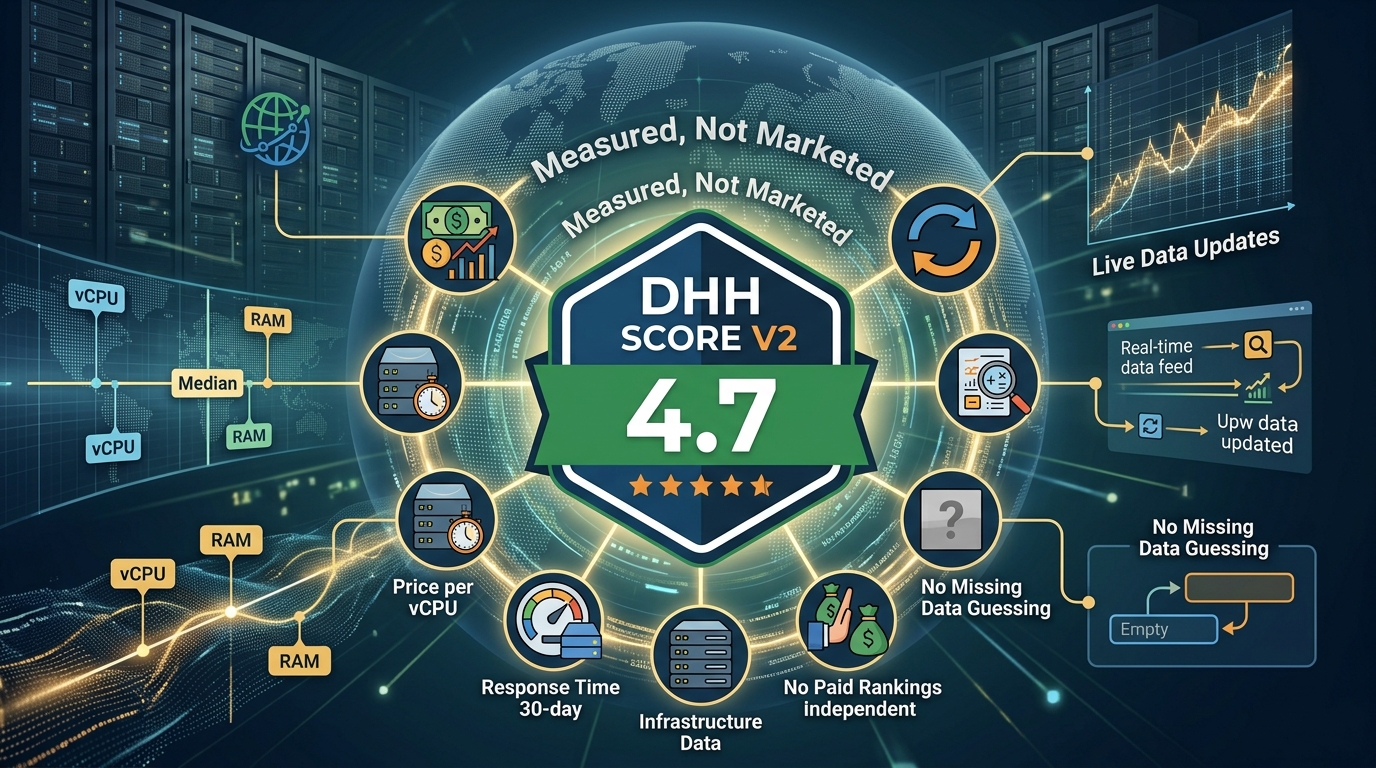
DohoHub introduces DHH Score V2, a more transparent, data-driven way to rate hosting providers using measured price, uptime, response time, and available market data — not paid rankings or invented scores.
Introducing the DHH Score V2
A more transparent way to measure hosting providers
Hosting prices change. Infrastructure changes. Performance changes.
So why should a hosting score remain static?
Today, DohoHub is introducing the DHH Score V2 — an updated approach to measuring hosting providers using data that can actually be collected, compared and verified.
The goal is simple:
Less marketing. More measurable data.
The DHH Score is designed to give users a consistent way to compare hosting providers without relying on manually assigned ratings or promotional claims.
What is the DHH Score?
The DHH Score is DohoHub's independent provider rating system.
It combines measurable characteristics of a hosting provider into a single score on a 0–5 scale, while keeping the underlying methodology visible.
Unlike a traditional editorial rating, the score is not manually assigned by a reviewer.
It is calculated from data collected and measured by DohoHub.
That means a provider's score can change when its pricing, uptime or measured performance changes.
And importantly, a provider cannot purchase a higher score.
What's new in V2?
The biggest change in DHH Score V2 is the move toward a more data-driven and transparent scoring model.
Instead of attempting to score everything a hosting company offers, V2 focuses on the factors DohoHub can measure consistently across providers.
V2 focuses on:
- Price and value
- Measured uptime
- Measured response time
- Available provider data
- Comparable infrastructure information
The model also avoids inventing values when information is unavailable.
If DohoHub cannot reliably measure a component, that component is not simply given an assumed score.
This is important because missing data is not the same thing as poor performance.
1. Price
Price remains one of the most important parts of the DHH Score.
But V2 does not simply reward whoever advertises the lowest monthly number.
Hosting plans can have completely different amounts of CPU, RAM and storage, making headline prices difficult to compare.
For infrastructure plans where comparable specifications are available, DohoHub normalizes pricing around:
- Price per vCPU
- Price per GB of RAM
- Price per 100 GB of storage
Prices are converted to a common USD basis and compared against the current catalogue median for the relevant plan type.
The median represents the market benchmark.
A provider priced around the market median receives a middle score, while significantly cheaper infrastructure scores higher and significantly more expensive infrastructure scores lower.
This makes the price component about relative value, rather than simply the cheapest advertised number.
2. Uptime
V2 also uses DohoHub's own uptime measurements.
Instead of relying exclusively on provider status pages, DohoHub monitors provider websites directly.
The monitoring system checks endpoints continuously and aggregates the results over a rolling 30-day period.
The current methodology uses:
- Checks approximately every 5 minutes
- A 15-second timeout
- Failure confirmation before recording an outage
- A 30-day measurement window
A provider reaching 100% measured availability receives the maximum uptime component score, while performance at or below the defined lower threshold receives zero points.
This gives DohoHub an independently measured reliability signal rather than simply repeating a provider's own uptime claim.
3. Response time
Availability alone does not tell the whole story.
A website can be technically online while responding slowly.
That's why V2 also considers measured response time.
DohoHub measures the response time of the same monitored endpoint used for uptime calculations.
Faster response times receive higher scores.
The current methodology gives the maximum response component score to response times of approximately 100 ms or faster, with the score decreasing as latency increases.
This creates a separate performance signal from uptime.
Missing data is not a zero
One of the most important principles behind DHH Score V2 is:
If we don't have reliable data, we don't make it up.
Some providers publish detailed infrastructure specifications.
Others don't.
Some plans provide enough CPU, RAM and storage information to make a meaningful comparison.
Others don't.
V2 therefore excludes unavailable components rather than assigning arbitrary values.
The weights are automatically re-normalized across the components that can actually be measured.
This makes the score more honest when providers have different levels of publicly available information.
Why some providers may have no score
A provider without a DHH Score is not automatically a poorly performing provider.
It may simply mean that DohoHub does not have enough comparable data to calculate a meaningful score.
For example, shared hosting often does not provide standardized vCPU and RAM specifications.
Using disk space alone would create a misleading comparison because advertised shared-hosting storage is often not directly comparable.
Rather than manufacture a score from incomplete information, DohoHub can leave the provider unrated.
The same principle applies to specialized infrastructure where comparable specifications are not yet available.
No score means insufficient data — not a negative rating.
What V2 deliberately does not score
DHH Score V2 is intentionally limited.
DohoHub does not attempt to convert every marketing claim into a number.
At this stage, the formula does not directly assign a score for things such as:
- Customer support quality
- Security feature lists
- Money-back guarantees
- Marketing claims
- Brand reputation
- Data-center count
- Feature quantity
These things can still be useful when comparing providers.
They simply aren't treated as objective numerical components unless DohoHub can measure them consistently.
What about reviews and community feedback?
Reviews and community feedback remain useful parts of the DohoHub ecosystem.
However, a review should not automatically become an artificial performance measurement.
DohoHub therefore keeps user-generated information separate from directly measured infrastructure data unless there is sufficient, structured information to incorporate it responsibly.
The result is a distinction between:
What DohoHub measures
and
What users report.
Both can be useful — but they are not the same type of evidence.
The score is relative
Another important change in the way users should understand the DHH Score is that it is not a permanent grade.
Hosting is a competitive market.
If one provider lowers its prices, improves performance or changes its infrastructure, the relative position of other providers can change as well.
The price component in particular is benchmarked against the current market catalogue.
That means the DHH Score can move even when a provider itself has not made a major change.
This is intentional.
The score describes a provider relative to the market data available at that time.
Live data changes the score
DohoHub continuously tracks the hosting market.
Prices are re-checked from provider websites, while uptime and response time are independently monitored.
As the underlying data changes, the DHH Score can change.
This makes the score fundamentally different from a traditional review published once and left unchanged for years.
A provider that was competitive six months ago may become less competitive after a major renewal-price increase.
A provider that improves its pricing or infrastructure can move in the opposite direction.
The score is therefore designed to reflect the market as it changes.
No paid rankings
The DHH Score is independent of commercial placement.
Affiliate relationships, promoted listings and commercial partnerships do not determine the score.
A provider cannot pay DohoHub to receive a higher rating.
A promoted placement can provide additional visibility.
It does not change the underlying calculation.
This separation is central to the DohoHub model:
Paid visibility is not paid ranking.
Why we built V2
Hosting comparison sites often combine editorial opinion, affiliate relationships, promotional prices and manually assigned ratings.
That can make it difficult to understand what a rating actually represents.
DHH Score V2 takes a different approach.
Instead of asking:
"Which hosting company do we like?"
the system asks:
"What can we actually measure?"
Then it builds the score from those measurements.
That does not mean a single number can describe every aspect of a hosting company.
It cannot.
The purpose of the DHH Score is narrower:
to provide a consistent, transparent and continuously updated data point for comparing providers.
DHH Score V2 at a glance
| Component | What DohoHub measures |
|---|---|
| Price | Normalized infrastructure cost relative to the market |
| Uptime | Independently measured availability |
| Response | Independently measured response time |
| Reviews | Kept separate unless sufficient structured data exists |
| Missing data | Excluded rather than guessed |
| Scale | 0–5 provider score |
| Updates | Changes as underlying market data changes |
| Paid placement | Does not affect the score |
From ratings to market data
DHH Score V2 is part of a broader change in how DohoHub approaches hosting comparisons.
DohoHub is not trying to replace detailed provider research with one number.
Instead, the score sits alongside:
- Live hosting prices
- Renewal prices
- Plan specifications
- Uptime monitoring
- Response-time measurements
- Price history
- Data-center information
- Security information
- Provider reviews
- Deals and promotions
- Market price indexes
The score provides a quick signal.
The underlying data provides the context.
The principle behind DHH Score V2
We believe a hosting score should be:
Measured, not marketed.
It should be reproducible.
It should be transparent.
It should change when the underlying data changes.
And when the data isn't available, it should say so.
That's the idea behind DHH Score V2.
No paid rankings. No black-box editorial score. No invented data. Just measurable hosting data — continuously monitored.
Learn more about the methodology on DohoHub's About page.